
Here to serve the people of Montana and its livestock industry.
Animal Health Bureau
- Permits & Forms
- Brucellosis
- Brucella canis
- Feral Swine
- High Path Avian Influenza
- Johne's
- Rabies
- Trichomoniasis
- West Nile Virus
- National Poultry Improvement Program (NPIP)
- Pay for Permits Online
Helpful Links
Contact Information
Department of Livestock
Animal Health Bureau
PO Box 202001
Helena, MT 59620-2001
Email: livpermits@mt.gov
FY26 Q1-Q2 Disease Reporting
Designated Surveillance Area & Brucellosis
The designated surveillance area (DSA) is an area in southwest Montana where Brucella abortus infected wildlife exist and can potentially expose and infect cattle and domestic bison. Infection with B. abortus (brucellosis) causes reproductive failure in cattle. Brucellosis is a zoonotic disease that can cause severe, chronic illness in humans and is transmitted through ingestion of unpasteurized dairy products or exposure to infected tissues (e.g., placenta, fluids). Cattle and domestic bison in the DSA are required to meet specific testing, identification, and vaccination requirements designed to prevent movement of brucellosis out of the DSA.
Routine brucellosis testing is done on blood samples drawn from cattle and bison by accredited veterinarians and submitted to the Montana Veterinary Diagnostic Laboratory. Reasons that animals might be tested for brucellosis include:
- Ranch testing includes required testing conducted on animals for movement or change of ownership in the DSA as well as voluntary testing on DSA animals. Most months ranch testing constitutes the largest component of total brucellosis testing.
- Market testing is testing conducted pre-sale on DSA animals that are consigned to one of Montana’s approved livestock markets.
- Epi testing is conducted by state or federal veterinarians on brucellosis affected herds.
- Slaughter testing is conducted on all sexually intact animals over 12 months of age slaughtered at state inspected slaughter facilities.
- CSS testing is conducted on bulls housed at several studs in Montana that follow certified semen service protocols.
- The other testing category includes testing conducted for any other reason such as for export.
When an animal is identified as non-negative on a routine brucellosis test, DOL conducts further testing on the individual animal, and if the animal is confirmed positive for brucellosis DOL investigates the animal’s history and the source herd is designated as affected with brucellosis. Montana has two longstanding brucellosis affected herds that remain under quarantine and conduct annual herd tests each fall. During FY26 DOL identified two new brucellosis affected herds:
- In July 2025, a single brucellosis infected bull was found on a routine market test. The herd of origin was placed under quarantine and completed a whole herd test in October 2025. No additional infected animals were identified, the investigation was completed, and the herd was released from quarantine.
- In December 2025 a single brucellosis positive animal was identified as part of a voluntary, annual, whole herd test in Gallatin County. The positive animal was a first calf heifer, and the herd had several years of whole herd testing history which allowed for a very short quarantine with minimal additional testing required.
Montana Brucellosis Testing FY25 and FY26 Year to Date Comparison
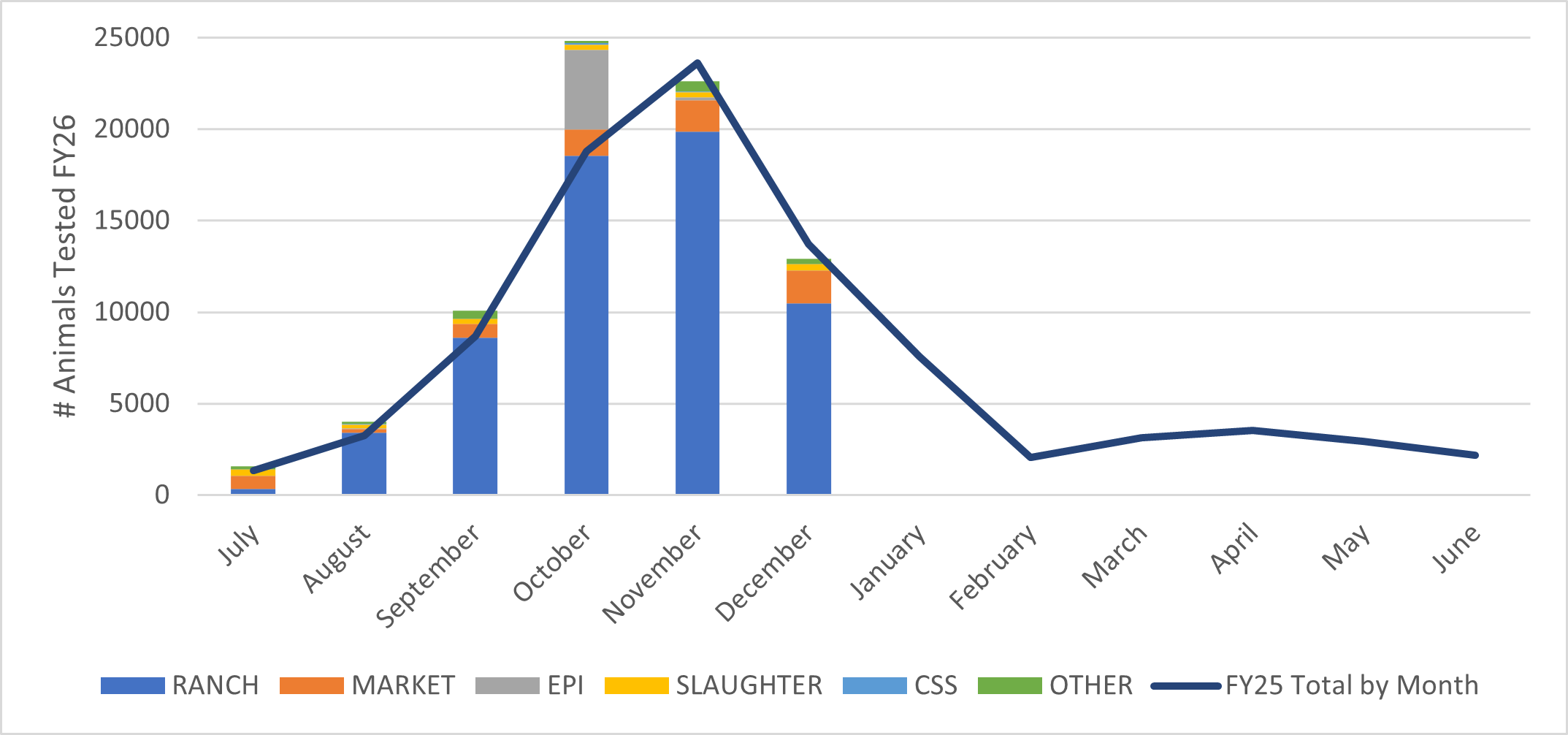
Figure 1. The chart above shows the number of animals tested by month in Fiscal Year (FY) 25 compared to the number of animals tested by month in FY26. The testing for FY26 is broken down by category of test. See below for a more detailed explanation of testing types. Test volume is generally consistent from year to year but can be affected by conditions such as cattle market conditions, drought and availability of feed within the DSA, and the number of brucellosis affected herds being tested under quarantine. Testing is seasonal with a peak in the fall and early winter during the period of the cattle production cycle when most cattle are moved or sold and when it is most convenient to conduct voluntary whole herd tests.
Brucella canis
Brucella canis (B. canis) is a zoonotic, bacterial disease of dogs and is a reportable disease in Montana. Sexually intact dogs used for breeding or that are allowed to roam freely in feral populations are at the greatest risk of becoming infected with B. canis. To date, there is no known effective treatment for infected dogs. Current management efforts focus on euthanasia of infected animals or quarantine of infected animals with repeated testing. As a zoonotic agent, B. canis is a risk to public health.
All data reported here is from tests performed at the Montana Veterinary Diagnostic Laboratory (MVDL). Data includes the MVDL ELISA and IFA results, which are considered screening tests and do not definitively confirm infection. B. canis is challenging to conclusively diagnose due to its biology and the diagnostic effort required to isolate the organism. The following results indicate ongoing surveillance efforts for B. canis and provide some insight into the prevalence of this disease within the tested canine population over this reporting period. However, challenges remain in accurately assessing the burden of this disease across the state due to an unknown proportion of samples being sent to outside labs and a decline/lack of testing in certain areas.
| Month | Total Number of Tests | Total Number of Positive Tests | |
|---|---|---|---|
|
July |
22 |
4 |
2 |
|
August |
25 |
7 |
4 |
|
September |
35 |
6 |
4 |
|
October |
36 |
3 |
0 |
|
November |
16 |
0 |
0 |
|
December |
25 |
2 |
2 |
|
Grand Total |
159 |
22 |
12 |
Table. 1 The table above summarizes B. canis testing conducted at MVDL in FY26 Q1 and Q2. Categories reflecting total number of tests may include re-tests, as well as tests conducted on canines that do not reside in Montana. The number of new animals with positive tests indicates the number of individual animals with a positive MVDL test that have not previously been tested at MVDL.
Case Definitions and Management Guidance for B. canis testing as Determined by DOL 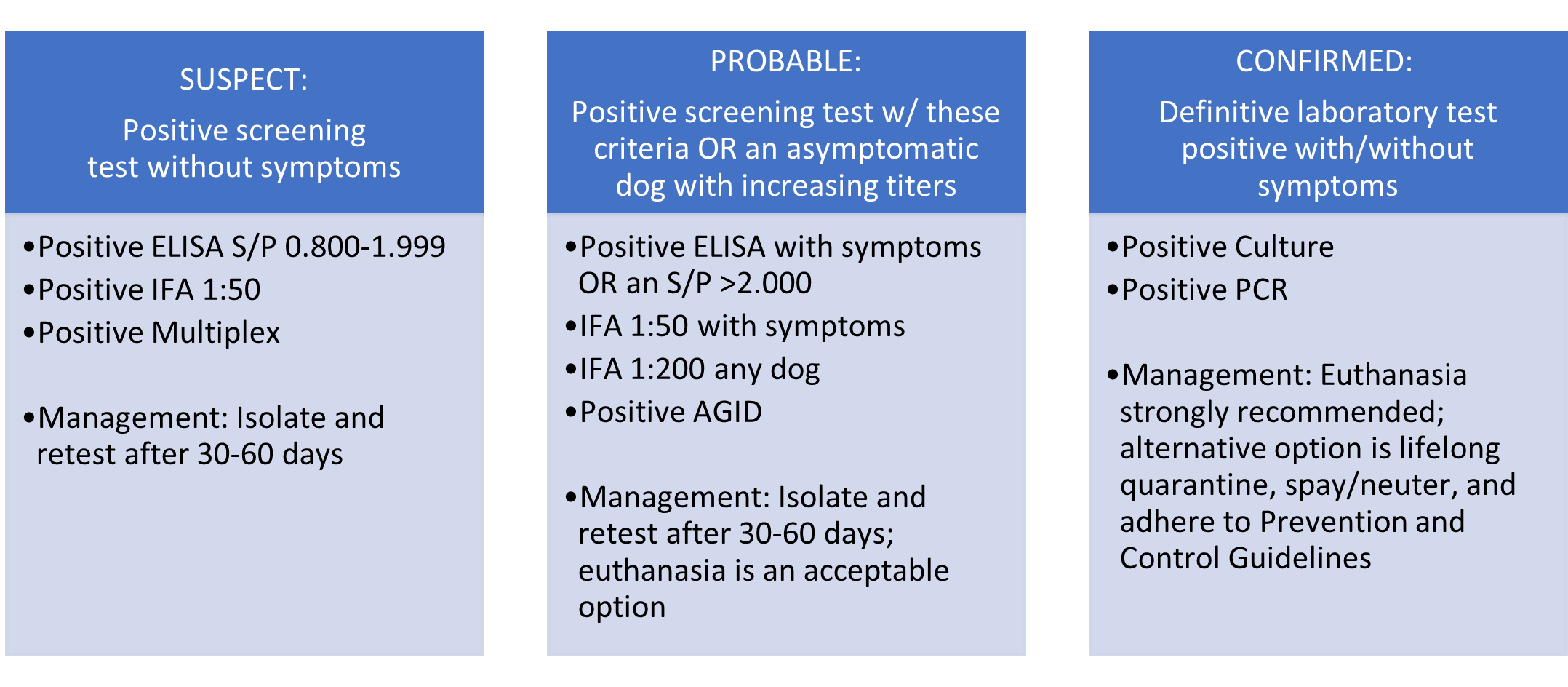
Historical Montana B. canis Testing FY25-FY26 YTD
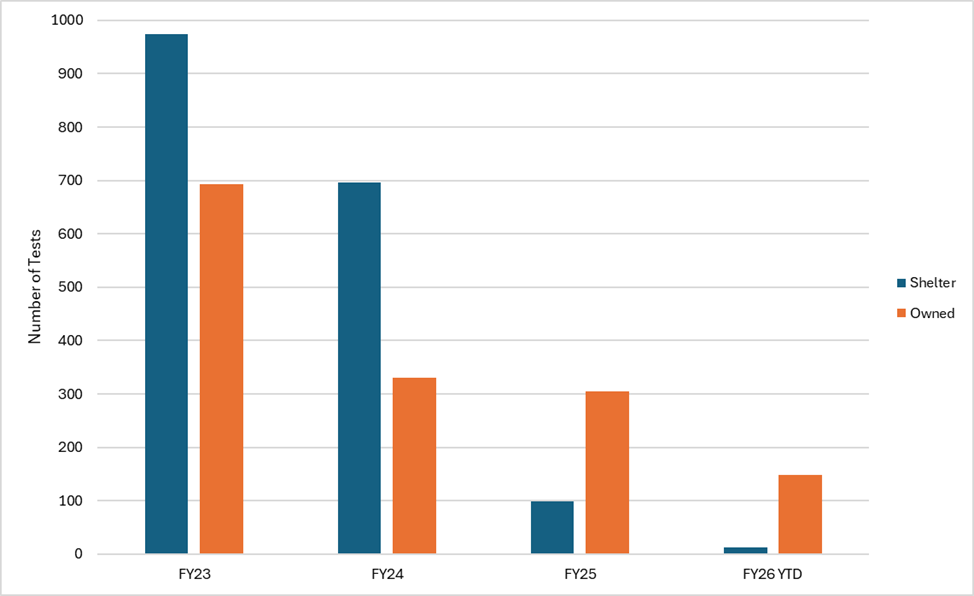
Figure 2. The figure above compares the number of B. canis tests conducted on sheltered vs owned dogs during FY23-25 and FY26 year to date. There has been a significant decline in testing overall, but most notably among shelter-owned animals. Causative factors or contributors to this decline are thought to be multifactorial, with major factors relating to emotional burnout among shelters and veterinarians (due to high rates of euthanasia for B. canis infected dogs), limited resources, education, and variable guidance from animal and public health authorities.
Johne’s Disease
Johne’s disease is caused by the bacterium Mycobacterium avium subspecies paratuberculosis, which can infect all ruminant species. The disease is contagious with infection leading to progressive weight loss (despite animals maintaining their appetite), diarrhea, and eventually death. Progression of disease is usually slow, and older animals are most likely to be clinically affected. However, most animals become infected early in life (calfhood). There is no treatment for Johne’s disease, it can cause significant production losses, and it is reportable in Montana.
Johne's Disease Testing Summary, FY26 Q1 and Q2 (Combined)
| Month | Total Number of Accessions | Total Number of Accessions with Positive or Suspect Animals |
|---|---|---|
|
July |
21 |
4 |
|
August |
32 |
6 |
|
September |
26 |
10 |
|
October |
38 |
13 |
|
November |
38 |
8 |
|
December |
35 |
8 |
|
Total |
190 |
49 |
Table 2. This table demonstrates the total number of accessions (submissions) for Johne’s disease submitted by month during the first two quarters of FY26, as well as the number of those accessions that contained either positive or suspect results. Reporting results based on accessions versus individual animals provides better insight for estimating the potential prevalence of disease at the herd-level across Montana’s cattle population. However, some herds might have submitted more than one accession during the reporting period.
Top Counties by Johne’s Disease Testing Rate per 100,000 Animals, FY26 Q1 and Q2
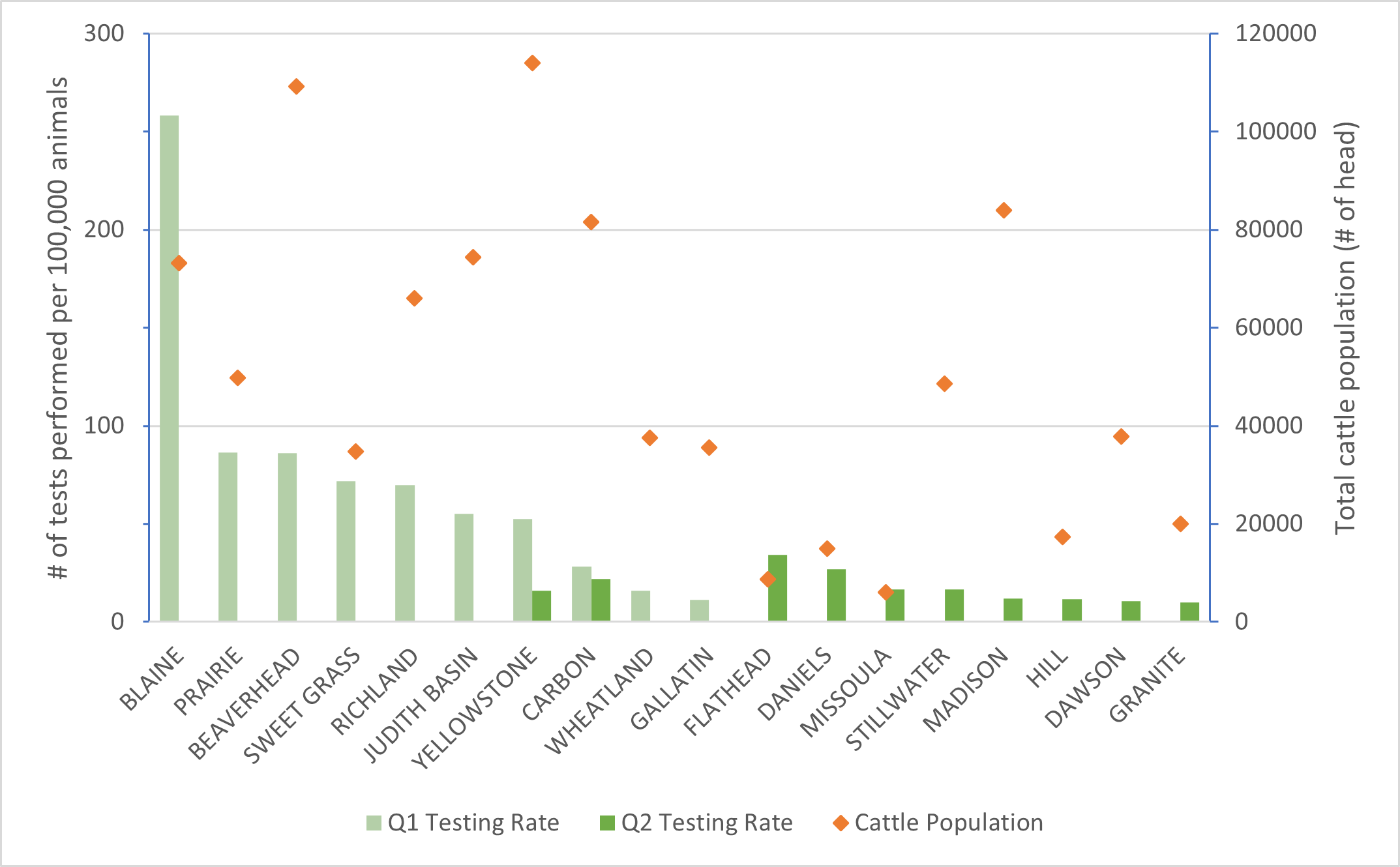
Figure 3. The figure above illustrates the overall rate of Johne’s Disease testing by county (bars) and total cattle population size by county (points). The top 10 counties with the highest rates of testing for Q1 and Q2 are shown (counties with <5000 head of cattle were excluded from ranking). Rates were calculated using the total number of diagnostic tests (ELISA and PCR) for Mycobacterium avium ssp. paratuberculosis (Johne’s Disease) performed at MVDL for Q1 and Q2 divided by the total cattle population by county, then standardized to rates per 100,000 animals. Comparing population size to testing rates illustrates significant differences in testing effort across the state. For example, Fergus County, having the highest cattle population in the state, had a testing rate of only 1 animal per 100,000 and 3 animals per 100,000 in Q1 and Q2, respectively. Overall, it appears that testing efforts in many of the counties hosting the largest cattle populations is minimal. This is likely a reflection of the challenging diagnostic and economic factors that are involved for Johne’s testing but will require a closer evaluation in the coming months.
Historical Montana Johne’s Testing Data FY18-FY25
| Fiscal Year | Total Number of Tests | Total Number of Positive Tests | Percent of Positive Tests |
|---|---|---|---|
|
FY18 |
3223 |
157 |
5% |
|
FY19 |
4836 |
818 |
17% |
|
FY20 |
6700 |
241 |
4% |
|
FY21 |
9478 |
391 |
4% |
|
FY22 |
9155 |
279 |
3% |
|
FY23 |
8651 |
346 |
4% |
|
FY24 |
7800 |
260 |
3% |
|
FY25 |
5964 |
247 |
4% |
Table 3. The table above presents the total annual number of Johne's disease tests conducted from FY18 to FY25. The overall number of tests has varied from year to year. These variabilities likely indicate fluctuations in cattle population numbers and testing efforts across the state. Producers may choose to test if they are seeing production impacts and want to decrease the prevalence of infection in their herd or if they are marketing animals and want to be able to provide buyers with an assurance that animals are not likely to be infected.
Rabies
Rabies is a fatal viral disease that can affect any mammal. Bats are the most common wildlife reservoir of rabies in Montana with occasional skunk cases found in the southern part of the state. Rabies vaccination for domestic animals is highly effective at preventing the disease. Unvaccinated animals exposed to rabid animals are euthanized or are required to undergo a lengthy quarantine period to ensure they do not develop rabies. Rabid animals pose a significant public health risk.
Montana Rabies Testing FY26 Q1 and Q2
|
Quarter 1 (July to September 2025) |
||||
|
Negative |
Positive |
Unsuitable |
Total |
|
|
Cat/Dog |
63 |
0 |
2 |
65 |
|
Livestock |
7 |
0 |
2 |
9 |
|
Bat |
168 |
23 |
34 |
225 |
|
Raccoon |
7 |
0 |
0 |
7 |
|
Skunk |
3 |
0 |
1 |
4 |
|
Other wildlife |
6 |
0 |
1 |
7 |
|
Totals |
254 |
23 |
40 |
317 |
|
Quarter 2 (October to December 2025) |
||||
|
Cat/Dog |
34 |
0 |
0 |
34 |
|
Livestock |
3 |
0 |
0 |
3 |
|
Bat |
4 |
1 |
1 |
6 |
|
Raccoon |
4 |
0 |
0 |
4 |
|
Skunk |
2 |
0 |
0 |
2 |
|
Other wildlife |
4 |
0 |
0 |
4 |
|
Totals |
51 |
1 |
1 |
53 |
Table 4. The table above presents a detailed rabies testing summary for various animal species across Q1 and Q2 for FY26. Testing and rabies exposure incidents tend to occur seasonally based on the biology of the disease’s main wildlife reservoir (bats). The most common animals tested were bats each month followed by dogs and cats. All rabies positive cases identified by MVDL were in bats.
Positive Rabies Cases in Montana FY26 Q1 – Q2 (July-December 2025)
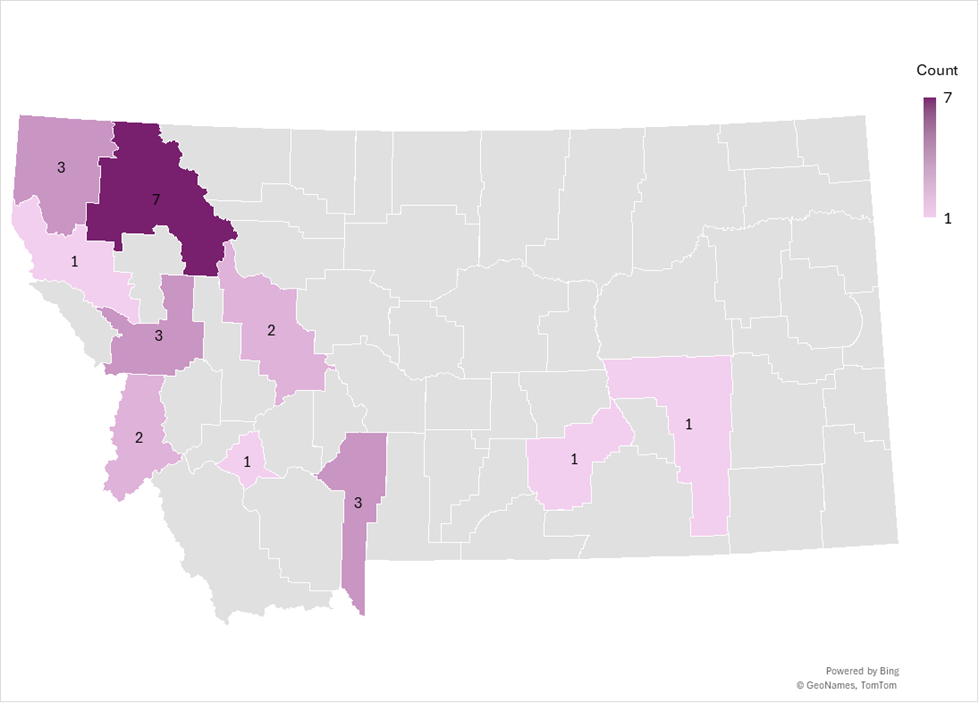
Figure 4. The map above shows the county-level distribution of positive rabies cases in FY26 Q1. The highest incidence of rabies cases occurred in the NW region of Montana for this quarter.
For more information on historical rabies test data, please view an interactive Rabies Positives by County map.
Trichomoniasis
Trichomoniasis is a reproductive disease of cattle caused by the protozoal parasite Tritrichomonas foetus. It is spread through live breeding and although cows can clear the infection, bulls remain infected long term. Infection in a herd leads to infertility, early pregnancy loss, and extended calving intervals.
To date, trichomoniasis remains well controlled across the state and animals are rarely found to be infected. Successful management of this disease has been achieved through continued efforts in testing, either through elective or regulatory testing of bulls intended for sale, turnout, and/or impending intra/interstate movements. Montana requires trich testing for bulls being imported into the state, coming from multiple sources to common pastures for breeding, and for bulls being sold/loaned/leased or moved out of the trich epizootic counties (Big Horn, Glacier, Pondera, and Yellowstone).
Trichomoniasis Testing by County FY26 Q1 – Q2
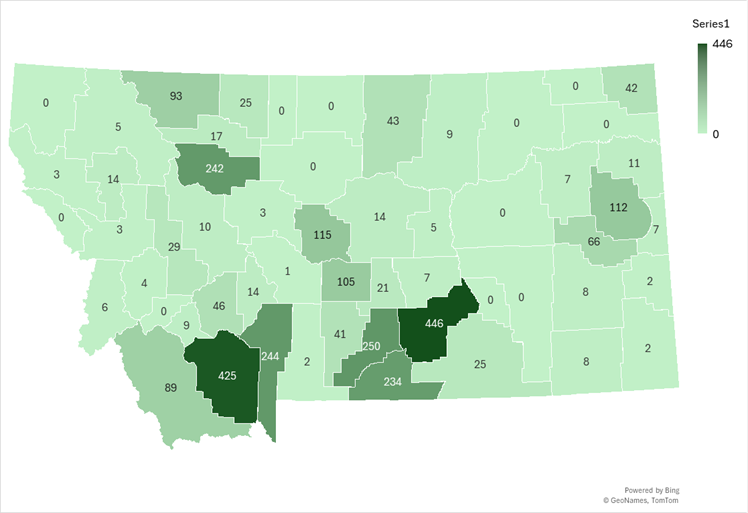
Figure 5. The map above illustrates the distribution of bovine Trichomoniasis tests across various counties in FY26 Q1. Yellowstone County and Carbon County contain several Certified Semen Services facilities which conduct routine testing for trichomoniasis.
View an interactive map for Trichomoniasis testing.
Montana Trichomoniasis Testing FY17-FY25
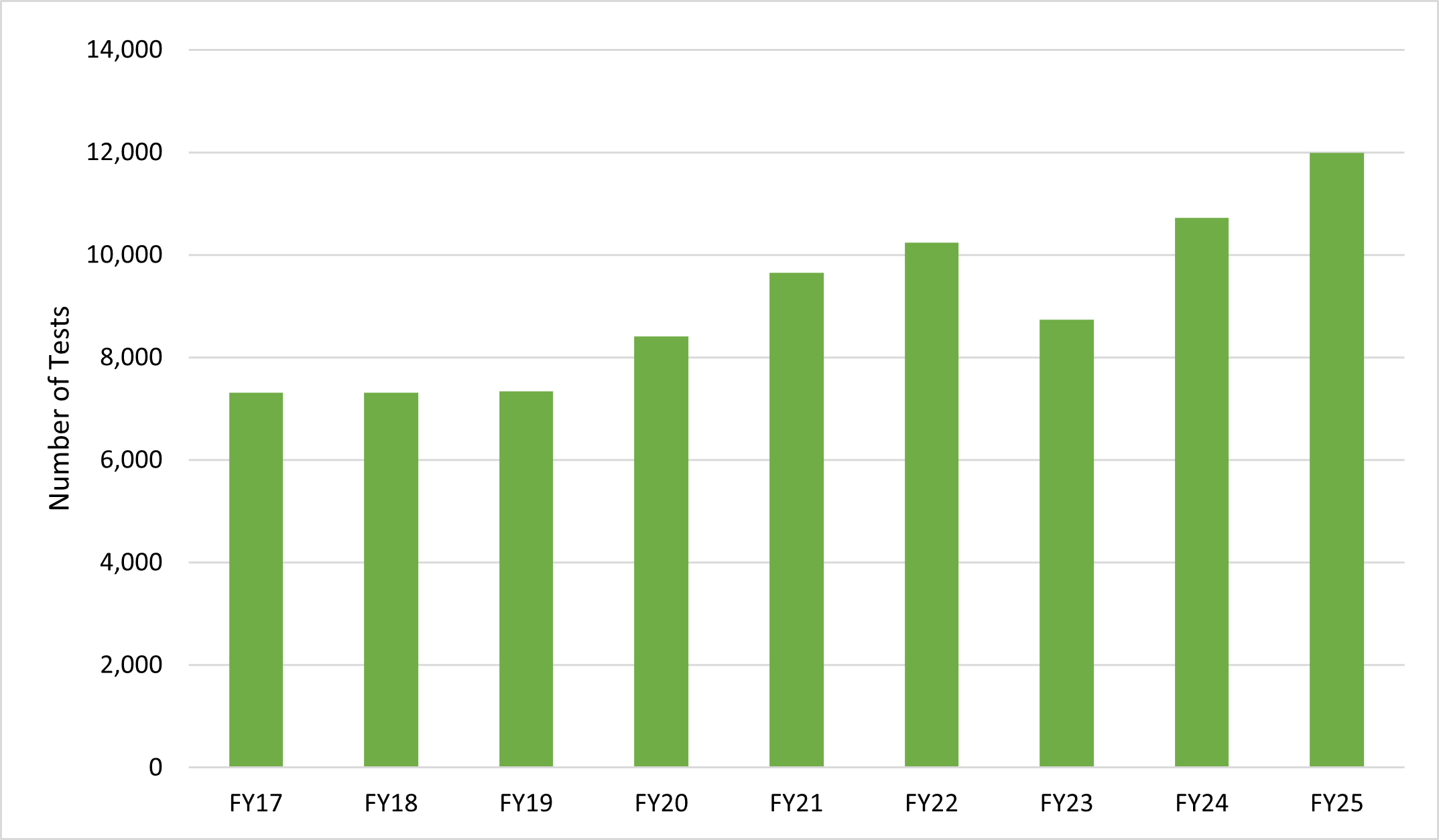
Figure 6. The graph above provides an annual overview of the total number of Trichomoniasis tests conducted in Montana from FY17 to FY25.
Bull Trichomoniasis Testing by Month, FY26 Q1 - Q2
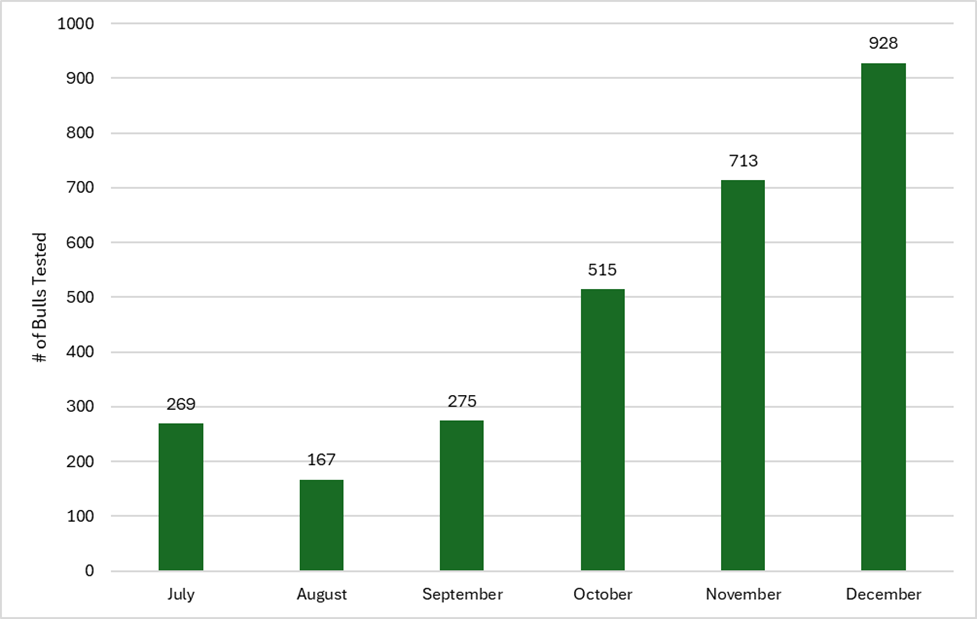
Figure 7. The figure above illustrates the total number of Trich tests performed at MVDL for Q1 and Q2.
Montana Foreign Animal Disease (FAD) Investigations FY26
Foreign animal diseases (FADs) are those diseases which do not currently occur in or are not endemic to the United States. Introduction of an FAD to the United States would have significant economic and animal health consequences. Since February of 2022, the United States has been dealing with an outbreak of highly pathogenic avian influenza (HPAI), and Montana continues to respond to numerous sick bird calls. Most cases of HPAI are caused by virus from wild birds spilling over into domestic poultry. Other disease investigations are more sporadic and usually result from accredited veterinarians reporting suspicious illnesses.
Foreign Animal Disease Investigations FY26 Quarter 1&2 (July-September 2025)
| Disease Investigated | Species | Month | County | Result |
|---|---|---|---|---|
|
High Path Avian Influenza |
Bovine |
July |
Powder River |
Low Risk (Untested) |
|
Vesicular Stomatitis |
Equine |
July |
Gallatin |
Negative |
|
High Path Avian Influenza |
Chicken |
August |
Yellowstone |
Negative |
|
High Path Avian Influenza |
Turkey |
August |
Stillwater |
Negative |
|
Vesicular Stomatitis |
Equine |
August |
Blaine |
Negative |
|
Vesicular Stomatitis |
Equine |
September |
Meagher |
Negative |
|
High Path Avian Influenza |
Turkey |
September |
North Central MT |
Positive |
|
High Path Avian Influenza |
Chicken |
September |
Broadway |
Positive |
|
High Path Avian Influenza |
Chicken |
September |
Beaverhead |
Positive |
|
High Path Avian Influenza |
Chicken |
October |
Park |
Positive |
|
High Path Avian Influenza |
Poultry |
October |
Yellowstone |
Positive |
|
High Path Avian Influenza |
Poultry |
October |
Cascade |
Positive |
|
High Path Avian Influenza |
Poultry |
October |
Valley |
Positive |
|
High Path Avian Influenza |
Chicken |
October |
Flathead |
Negative |
|
High Path Avian Influenza |
Chicken |
October |
Fergus |
Positive |
|
Vesicular Stomatitis |
Equine |
December |
Custer |
Negative |
|
Foot and Mouth Disease |
Caprine |
December |
Madison |
Negative |
Table 5. The table above outlines the Foreign Animal Disease (FAD) investigations carried out in Q1 and Q2 in various counties. The only positive cases were for highly pathogenic avian influenza. All other investigations were negative for foreign animal diseases.
Montana Reportable Diseases FY26
The following list includes diseases that are reportable to the Department of Livestock (DOL) and diseases that are also reportable to USDA based on the reporting that the United States submits to the World Organization for Animal Health. Montana DOL tracks all reportable diseases across the state as information becomes available. Responses to disease reports are context specific and dependent on the disease itself, timing, location, needs, and other various factors. For example, some reportable diseases are quarantinable and require immediate action and investigation by the Department. Most information on reportable disease cases comes from testing conducted at the Montana Veterinary Diagnostic Laboratory, although accredited veterinarians will also report cases tested at other laboratories.
Montana Reportable Diseases Summary, FY26 Q1 and Q2 (Combined)
| Test Name | Total Number of Positive Tests | Total Number of Tests |
|---|---|---|
|
Anaplasmosis* |
107 |
355 |
|
Avian Influenza |
135 |
393 |
|
Bluetongue* |
22 |
112 |
|
Bovine Herpes Virus* |
26 |
161 |
|
Bovine Leukemia Virus* |
26 |
523 |
|
Bovine Viral Diarrhea |
1 |
531 |
|
Brucella canis* |
21 |
156 |
|
Brucella ovis* |
6 |
486 |
|
Campylobacter Culture |
0 |
361 |
|
Equine Infectious Anemia* |
2 |
3384 |
|
Heartworm* |
1 |
15 |
|
Johnes |
135 |
1907 |
|
Rabies Final Result |
24 |
375 |
|
Salmonella Culture |
0 |
57 |
|
Salmonella Enteritidis Culture |
18 |
1427 |
|
Salmonella Pullorum-Gallinarum MAT |
78 |
605 |
|
Trichinella - Pepsin Degradation |
0 |
1 |
|
Tritrichomonas |
0 |
1405 |
|
Vesicular Stomatitis |
0 |
29 |
|
West Nile Virus* |
14 |
22 |
Table 6. The table above shows testing for reportable diseases in Montana for FY26 Q1 and Q2. Please note, positive test results may not be confirmation of disease depending on the type of test conducted. *Indicate serology-based tests. Positive results from serologic-based tests demonstrate the presence of antibodies for a certain disease or pathogen, which may indicate active infection, prior exposure/past infection, or (in some cases) history of vaccination. Therefore, positive results shown here should be interpreted accordingly with the knowledge that a positive result does not necessarily indicate active infection in all cases. **This number includes tests conducted on wildlife.